Exploring “good enough” definitions of Ecosystem Condition
Lessons from Echo's workshop at the Nature Tech Unconference
There is broad consensus that Ecosystem Condition matters. It underpins biodiversity targets, climate commitments, and a growing class of nature-linked financial products. Should you have the chance to ask a room full of ecologists, technologists, and policymakers how to measure it, you’ll find consensus on principle diverges into varied practices. This tension between shared ambition yet divergent definition was the starting point for a workshop Echo Labs hosted at the Nature Tech Unconference in London held at the London School of Economics earlier this month.
Echo Labs is exploring how to build scientifically robust, reproducible methods for characterizing Ecosystem Condition. Because defining Ecosystem Condition in the abstract is a philosophical exercise, our fearless workshop leader (current Research Leader at Kew Gardens, and Echo’s incoming Director of Ecological Research Phil Wilkes) deliberately anchored the conversation in specific use cases to encourage groups toward creative discussion about what implementation of monitoring condition might actually require. A farmer managing a single holding, a government triaging ecosystem collapse across a region, and a fund manager structuring a nature credit were each asked about “condition,” while ultimately cultivating different priorities in-context. Given the unique opportunity of the Unconference format, we invited a room of experts to dive into the devilish details with us.
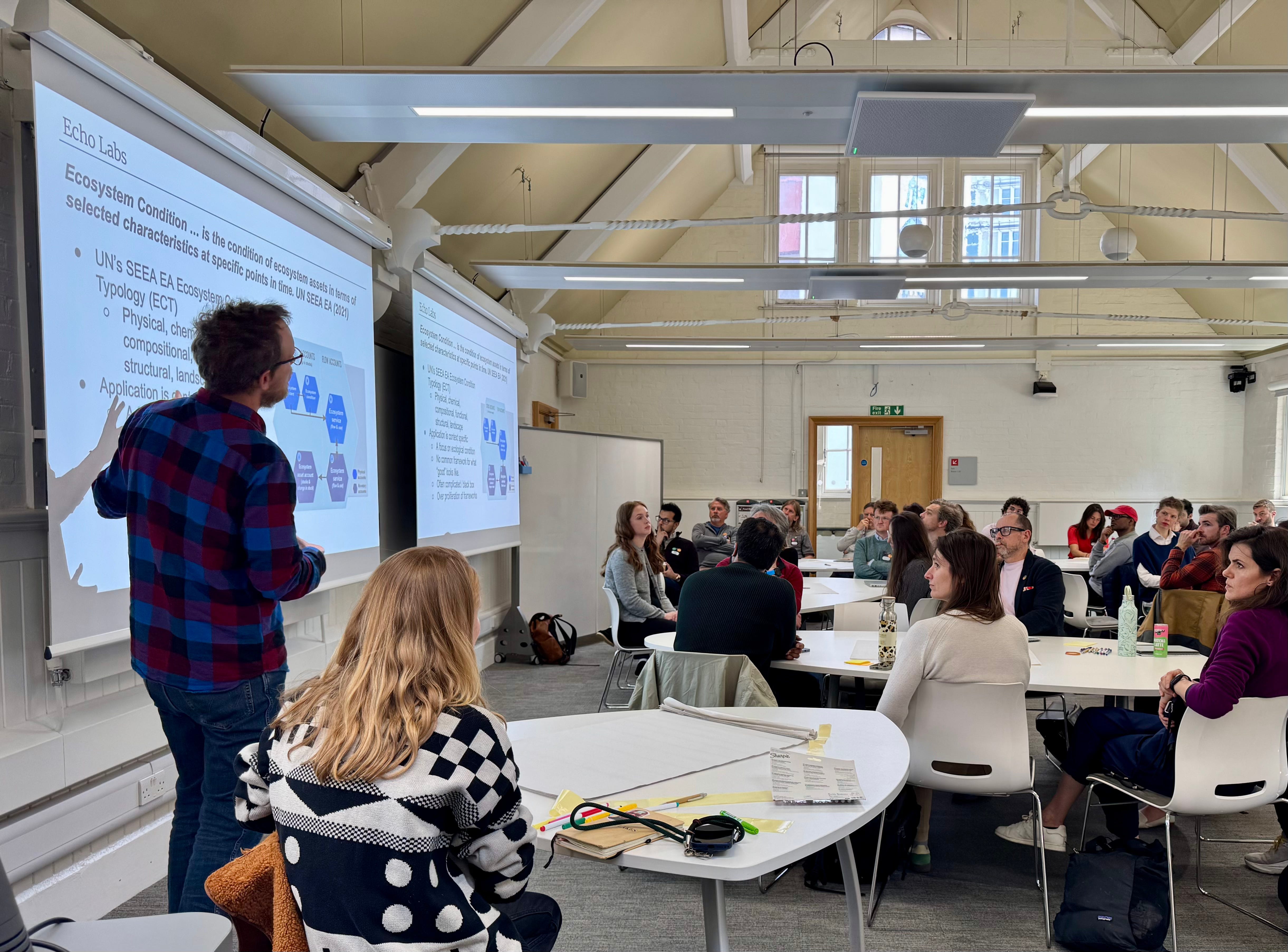
The audience, only briefly, until they were transformed into farmers and governments by Phil Wilkes, Echo Labs’ incoming Director of Ecological Research and workshop mastermind
What Emerged
Condition is inherently multi-scale, multi-stakeholder
No group arrived at a single metric for a single audience. Every scenario demanded frameworks that flex across spatial scales and serve multiple decision-makers. This is another beat of the drum that is establishing a firm rhythm that coordination and customization of Ecosystem Condition definitions or interpretations are key.
Tip-and-cue: remote sensing as a trigger
By now we all agree that sensing platforms are an essential data source, but workshop participants pointed out that remote and rapid detection methods could be equally essential for highlighting where to look. Known in the surveillance biz as “tip and cue,” remote sensing could automate coordination to identify areas of concern, then target ground sampling to confirm what’s actually happening or why. Strategically deploying each satellite and survey could be greater than the sum of their parts; powerful and cost-effective.
Relative baselines
Rather than reaching for idealized reference states, groups converged on time-zero relative baselines. While there are many solutions that currently use a reference state, the t₀-referenced approach felt most realistic in the context of tracking ecosystem condition over time. Which brings us to…
Frequency is the biggest gap
Groups repeatedly flagged that the biggest gap is less a matter of what gets measured than how often. Existing monitoring frameworks that provide consistent, high-quality assessments over large areas are often lagging measures by months if not years. For anyone trying to plan or track interventions, this is hardly better than flying blind.
Bonus item: definition challenges. As a part of the frequency discussion, there was a productive debate about terminology when “rate of change” and “trajectory” were both used as the desired outcomes. As in, if we have more frequent measures of condition we can start to track the trajectory/rate of change.
To me, these sound like vector direction and magnitude, or slope and sign (up or down, and how fast is it changing), but I’m going to neatly put these into my basket of terms that seem to lack a strong ecological consensus definition, cozied between other items in the basket like “resilience” and - indeed - “condition.”
The proxy problem
Surveys measure things like species assemblages, soil microbial communities, and vegetation structure. The people who fund, regulate, or manage land often need something more like a dashboard (who doesn’t love a dashboard) indicator or functional readout that tells them whether things are getting better or worse and by how much. The mapping between those two worlds is not well established. Bridging ecological metrics to “decision-ready” proxies is an open design challenge.
We love dirt, we hate budgets
While perhaps not as inevitable as death and taxes, the value of soil measures and challenges of budget constraints were universal across all groups and use cases. The desire for soil health measures was highlighted repeatedly as a desirable measure of Ecosystem Condition, alongside the recognition that any sampling design must be implementable within realistic budgets for individual projects and organizations.
Thank you
We are grateful to the Unconference organizers Nature Tech Collective for such an engaging event with the space for exploratory discussion, and participants who showed up engaged and with a collaborative spirit.